What are the best foods to lower blood pressure?
On this page
Vegetables, fruit and beans, with whole grains, nuts and low-fat dairy, and less of the salt hidden in packaged and restaurant food. Tested in trials as the DASH diet, that way of eating took about 11 points off systolic (the top number) in people with high blood pressure, and the drop showed within two weeks. No single food comes close to the whole plate.
Ask most people what to eat for blood pressure and they’ll tell you what not to eat. Less salt, no bacon, put the shaker away. Then they search for the one magic food, beet juice or garlic or a tea. Both miss the biggest result in the research, which came from adding food to the plate and changing the whole way of eating.
What we’d do
Add before you take away. Make half of every plate vegetables and fruit, eat beans or lentils most days, keep a handful of nuts around, and pick low-fat milk or yogurt. Then go after the salt that comes in packages and restaurant food, since that’s where most of it is. Take a home week before you start and another two to four weeks later, and you’ll see what it did for you.
If you have advanced kidney disease or take a medicine that raises potassium, ask your care team before you load up on potassium-rich foods or a salt substitute.
The trial that settled it
In 1997 researchers ran an experiment most diet studies can’t. They gave 459 adults every meal for 8 weeks, so nobody had to guess what anyone ate. Everyone started on a typical American diet low in fruit, vegetables and dairy. Then one group stayed on it, one got lots more fruit and vegetables, and one got the full plan, with fruit, vegetables, low-fat dairy and less saturated and total fat. The researchers kept everyone’s salt and weight the same the whole time, so whatever moved was the food.
| What they ate for 8 weeks | Systolic drop against the usual diet |
|---|---|
| More fruit and vegetables | 2.8 points |
| The full plan, everyone | 5.5 points |
| The full plan, the 133 people with high blood pressure | 11.4 points |
| The full plan, the 326 people without it | 3.5 points |
That 11.4 is the biggest drop of any single change on the list, and it came without anyone eating less salt or losing a pound. The National Heart, Lung, and Blood Institute says the drop showed within two weeks.
Four years later the DASH-Sodium trial gave 412 people the same plan at three salt levels for 30 days each. The plan with low salt ended up 11.5 points lower than the usual diet with high salt in people with high blood pressure, and 7.1 lower in people without it. The plan helped most when salt was high, so if you can’t fix the salt yet, fixing the plate still counts for a lot.
Why food lowers blood pressure
Think of salt and potassium on a seesaw. Salt makes your body hold water, which fills the pipes and raises the push. Potassium does the opposite. The American Heart Association explains that the more potassium you eat, the more sodium you lose in your urine, and potassium also eases the tension in your blood vessel walls. Vegetables, fruit, beans and dairy are where most potassium comes from.
Potassium from food lowers systolic by about 4 to 5 points in people with high blood pressure, by the 2017 US guideline’s table. When researchers pooled 22 trials with 1,606 people in 2013, more potassium took off about 3.5 points, with the effect in people who had high blood pressure. The 2025 US guideline recommends 3,500 to 5,000 mg of potassium a day, ideally from food. A medium banana has about 451 mg and half a cup of cooked sweet potato about 286.
The plate does more than potassium alone, though. In the 1997 trial, fruit and vegetables on their own took off 2.8 points and the full plan 5.5, so the dairy, the beans and nuts, and the cut in saturated fat added more on top.
The plate, in servings
The NHLBI’s version of the plan at 2,000 calories a day:
| Food | How much |
|---|---|
| Vegetables | 4 to 5 servings a day |
| Fruit | 4 to 5 servings a day |
| Grains, mostly whole | 6 to 8 servings a day |
| Low-fat or fat-free milk and yogurt | 2 to 3 servings a day |
| Meat, poultry and fish | 6 or fewer servings a day |
| Fats and oils | 2 to 3 servings a day |
| Nuts, seeds, beans and peas | 4 to 5 servings a week |
| Sweets | 5 or fewer a week |
The plan limits fatty meats, full-fat dairy, sweet drinks and sweets. Its sodium ceiling is 2,300 mg a day, and the NHLBI says 1,500 mg lowers blood pressure even further. The 2025 US guideline sets the same pair, under 2,300 mg and working toward 1,500.
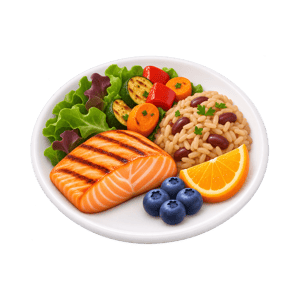
If counting servings sounds like homework, use the plate. Half of it vegetables and fruit, a quarter whole grains, a quarter beans, fish or chicken, and a glass of milk or a yogurt on the side.
The foods people ask about
Most of the famous single foods have been tested, and their effects are smaller and less sure than the whole plate’s.
| Food | What the trials found | How sure |
|---|---|---|
| Potassium-rich foods: bananas, potatoes, spinach, beans, yogurt | About 4 to 5 points in people with high blood pressure | Strong. Part of the plate |
| A potassium salt substitute | 3.3 points lower and about 14 percent fewer strokes in 20,995 older or post-stroke adults in rural China | Strong in that group. Not for kidney disease |
| Beet juice | 4.4 points lower in 16 small trials with 254 people, lasting from 2 hours to 15 days | Weak. Short trials |
| Hibiscus tea | 7.6 points lower in 5 trials with 390 people | Weak. Small trials, and the authors asked for better ones |
| Cocoa and dark chocolate | 1.8 points lower in 35 trials with 1,804 mostly healthy people, over 2 to 18 weeks | Moderate, and the effect is small |
A cup of hibiscus tea or a glass of beet juice is fine if you like them, and they come with no salt. But they were tested in small groups for days or weeks, and the plate was tested for 8 weeks with every meal provided.
The salt hidden in food
About 70 percent of the salt Americans eat is already in packaged and restaurant food before anyone picks up a shaker. Bread, deli meat, pizza, soup, cheese and sauces add up fast, so the quickest cuts come from checking the sodium on the label and ordering differently when you eat out. Why salt raises blood pressure has the mechanism and the list of foods that carry the most.
Who should be careful
- Advanced kidney disease, or a medicine that raises potassium. Ask your care team before adding a lot of potassium-rich food, and before any salt substitute or potassium supplement.
- Heart failure or a water pill. Agree on any big change in salt with your care team first.
- Pregnancy. The lowering list doesn’t apply. Follow your care team’s advice.
How to tell it worked
Take a home week before you change anything, and another two to four weeks later, with the same cuff, the same arm and the same times. Put both into the home average tool. A drop that holds across two weeks is real, and a shift of a few points may just be the normal wobble.
Food is the first change on how to lower your blood pressure naturally, and it’s the biggest. For the plate itself, meals.guide has what a balanced meal looks like, salad.guide has how to build a salad that works as a meal, and processing.guide has how to eat less ultra-processed food, which is where much of the salt lives.
13 sources
- Appel LJ et al., A clinical trial of the effects of dietary patterns on blood pressure (DASH), NEJM, 1997pubmed.ncbi.nlm.nih.gov
- Sacks FM et al., Effects on blood pressure of reduced dietary sodium and the DASH diet (DASH-Sodium), NEJM, 2001pubmed.ncbi.nlm.nih.gov
- NHLBI, DASH eating plannhlbi.nih.gov
- NHLBI, Why DASH Works, 2020internet-prod.nhlbi.nih.gov
- American Heart Association, How potassium can help prevent or treat high blood pressure, last reviewed 14 August 2025heart.org
- Whelton et al., 2017 ACC/AHA high blood pressure guideline, nonpharmacological table, as reproduced in the HSHS clinical guideline, 2019hshs.org
- Aburto et al., potassium intake, BMJ, 2013pubmed.ncbi.nlm.nih.gov
- Neal et al., SSaSS, NEJM, 2021, as reported by the ACCacc.org
- US Food and Drug Administration, Sodium in your dietfda.gov
- American College of Cardiology, New high blood pressure guideline emphasizes prevention, early treatment to reduce CVD risk, press release on the 2025 AHA/ACC guideline, 14 August 2025acc.org
- Siervo M et al., Inorganic nitrate and beetroot juice supplementation reduces blood pressure in adults, Journal of Nutrition, 2013pubmed.ncbi.nlm.nih.gov
- Serban C et al., Effect of sour tea (Hibiscus sabdariffa) on arterial hypertension, Journal of Hypertension, 2015pubmed.ncbi.nlm.nih.gov
- Ried K et al., Effect of cocoa on blood pressure, Cochrane Database of Systematic Reviews, 2017pubmed.ncbi.nlm.nih.gov