What does high blood pressure do to your body?
On this page
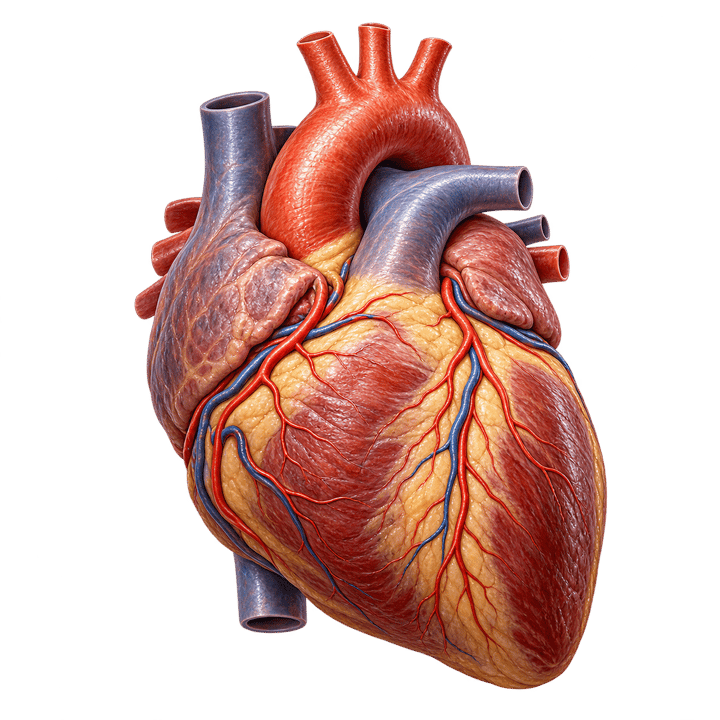
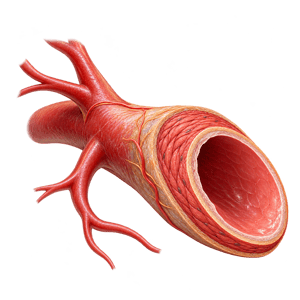
Over years, high pressure makes tiny tears in the lining of your arteries, plaque builds where they heal, the heart muscle thickens to push against the load, and the small vessels in your brain, kidneys and eyes wear out. You usually feel none of it. Then it shows up as a heart attack, a stroke, heart failure, kidney disease, vision loss or memory problems.
You can’t feel your blood pressure, so it’s easy to file it under numbers that don’t really mean anything. The American Heart Association says that in most cases the damage happens slowly over time, which is why nearly half of American adults have high blood pressure and only about 59 percent of them know.
What it does, part by part
Picture a garden hose with the tap turned up too high, every second of every day, for twenty years. The rubber gets stiff, it cracks in places, and the tap has to work harder to push water through.
| Part of you | What high pressure does there | What it can lead to |
|---|---|---|
| Artery walls | Tiny tears in the lining. The body patches them, and cholesterol and fat build up at those spots as plaque | Narrowed arteries, heart attack and stroke |
| Heart | It works harder against the pressure and can get bigger and stiffer | Heart failure, angina (chest pain) and heart disease |
| Brain | Blood vessels can get blocked or burst, and small vessels get damaged | Stroke, mild memory problems and dementia |
| Kidneys | Damage to the arteries around them stops them filtering blood the right way | Kidney disease and kidney failure |
| Eyes | Blood vessels in the eyes get strained or damaged | Vision loss |
| Sex | Less blood flow | Erectile problems in men and lower sex drive in women |
The 2025 US guideline added a new reason to act early. It recommends treating high blood pressure early partly to lower the risk of mild memory problems and dementia, since high pressure damages the small blood vessels in the brain.
How much the number counts
In 2002 researchers pooled 61 studies with one million adults and about 56,000 deaths from heart disease and stroke. At ages 40 to 69, every 20 points higher systolic went with about twice the death rate from heart disease and more than twice the death rate from stroke. The pattern held all the way down to 115/75, with no point where lower stopped helping.
From one million adults in 61 studies (Lewington 2002). The pattern held all the way down to 115/75, with no point where lower stopped helping. The doubling is about half as steep in your 80s, but the yearly risk is higher.
The doubling gets about half as steep by your 80s, but the yearly risk is higher at that age, so the same 20 points goes with more deaths each year.
It works the other way too. When researchers pooled 123 trials with 613,815 people in 2016, each 10 points off systolic cut major heart and blood vessel events by 20 percent, strokes by 27 percent, heart failure by 28 percent and deaths from any cause by 13 percent.
Why it climbs with age
Large arteries stiffen as you get older, so they stretch less with each heartbeat. In the Framingham data, systolic keeps rising across adult life, while diastolic rises at first and then falls after about 50 to 60. That widens the gap between the two numbers, which is why 150/70 is a common pattern in older adults and why systolic tells you more about your risk later in life. The healthy line stays under 120/80 at any age (normal for your age).
How we found all this out
The first published blood pressure measurement was done on a horse. In 1733 the English clergyman Stephen Hales described opening an artery in a mare’s leg and connecting it to a glass tube nine feet long. The blood rose 8 feet 3 inches. It had no use in a clinic, and none of his animals survived, but it showed that arteries hold blood under a pressure you can measure.
The cuff came in two steps. In 1896 the Italian doctor Scipione Riva-Rocci wrapped an inflatable cuff around the arm and connected it to a column of mercury, so nobody had to cut anything, but it only gave the top number. In 1905 the Russian surgeon Nikolai Korotkoff noticed that a stethoscope over the artery picks up sounds as the cuff lets go, and that the sounds start and stop at two pressures. That gave doctors both numbers. The unit is still millimeters of mercury because of those first cuffs.
For decades doctors could measure the number but didn’t know what it meant, and moderately high pressure was often called benign, as if it were harmless. The Framingham Heart Study changed that. It gave its first exam in 1948 and enrolled 5,209 people in a Massachusetts town, and over the years its researchers found that risk rose step by step with blood pressure, even at levels once called benign.
Then came the trials. The US Veterans Administration tested blood pressure drugs against placebo in men. The 1967 report covered men with a diastolic of 115 to 129, and that part stopped after about 18 months because the gap in serious events was so wide. The 1970 report covered 380 men with a diastolic of 90 to 114, and treatment came out ahead there too.
In 2015 SPRINT compared a systolic goal under 120 with one under 140 in 9,361 adults at raised risk. It stopped early, after a median of 3.26 years, with 25 percent fewer major heart events and 27 percent fewer deaths on the lower goal. Two years later the US guideline moved the line for high blood pressure to 130/80, where it still is.
What to do with this
The damage builds over years, so the useful move is to find your number now and bring it down early. A home week finds your real average, and how to lower your blood pressure naturally ranks every change by the points it took off. If you’re already at stage 2 or carrying other risks, blood pressure medicine: the case for and against helps you talk it through with your doctor.
High blood pressure rarely gives warning signs. With chest pain, shortness of breath, back pain, numbness, weakness, a change in vision or trouble speaking, call 911, whatever the number.
12 sources
- American Heart Association, Health threats from high blood pressure, last reviewed 14 August 2025heart.org
- American College of Cardiology, New high blood pressure guideline emphasizes prevention, early treatment to reduce CVD risk, press release on the 2025 AHA/ACC guideline, 14 August 2025acc.org
- Lewington S et al., Age-specific relevance of usual blood pressure to vascular mortality, The Lancet, 2002pubmed.ncbi.nlm.nih.gov
- Ettehad D et al., Blood pressure lowering for prevention of cardiovascular disease and death, The Lancet, 2016pubmed.ncbi.nlm.nih.gov
- SPRINT Research Group, A randomized trial of intensive versus standard blood-pressure control, NEJM, 2015pmc.ncbi.nlm.nih.gov
- Working Nurse, The gruesome origins of blood pressure measurement, on Hales 1733workingnurse.com
- Healio, The mercury sphygmomanometer: end of an era, on Riva-Rocci 1896 and Korotkoff 1905healio.com
- Wikipedia, History of hypertension, for the benign hypertension view and Framingham's findingen.wikipedia.org
- Framingham Heart Study, Historyframinghamheartstudy.org
- Veterans Administration Cooperative Study Group, JAMA, 1967 and 1970, in the NLM Edward Freis papersprofiles.nlm.nih.gov
- Franklin et al., Hemodynamic patterns of age-related changes in blood pressure, Circulation, 1997citedrive.com
- CDC National Center for Health Statistics, Data Brief 511, October 2024cdc.gov